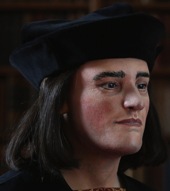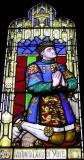
Richard, Duke of York (stained glass at St Laurence, Ludlow, © Worcestershire Branch, Richard III Society)
25 OCTOBER – Act of Accord
After unsuccessfully claiming his right to the crown in parliament on 10 October 1460, Richard, duke of York, had to accept the Act of Accord on 25 October 1460, which stipulated that he would be the heir to the throne after King Henry VI’s death, instead of the king’s son, Edward of Lancaster.
His claim was that while on his father’s side he was descended from Edward III’s fourth son, on his mother’s side he was descended from Edward III’s son. The Lancastrian Kings including Henry VI, however, were descendents of the third son of Edward III.
While the Duke of York’s claim ultimately failed, it was the basis for his son Edward IV to succeed to the crown.
More on the Act of Accord here.
Tags: Edward IV, Henry VI, Parliament, Richard Duke of York
Comments Off on Act of Accord
 Birth of Edward of Lancaster, only son of King Henry VI of England and Margaret of Anjou, at Westminster. He was the Lancastrian Prince of Wales. He was baptised on 14 October by William Waynflete, Bishop of Winchester.
On 13 December 1470 he was married to Anne Neville, who was 14 at the time, as part of an agreement between his mother, Margaret of Anjou, and Anne’s father, Richard Neville, Earl of Warwick (“The Kingmaker”) to return Henry VI to the throne. Edward fell at the Battle of Tewkesbury on 4 May 1471.
The picture shows the Palace of Westminster, how it supposedly looked in the 16th century.
Tags: Edward of Lancaster, Henry VI, Margaret of Anjou
Comments Off on 13 OCTOBER 1453
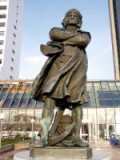
Statue of Christopher Columbus in Barcelona (D. Preis)
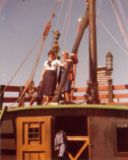
Replica of the Santa Maria (D. Preis)
Christopher Columbus arrives in America, or, more exactly, one of the islands in the Bahamas. A group of three ships, the Santa Maria, the Pinta and the Niña, left Spain on 3 August. They first sailed to the Canary Islands. From there, the journey across the Atlantic took 5 weeks.
In October 1977, I visited a replica of the Santa Maria, the largest of the three ships, in Barcelona – and was amazed how small it was. In the photo on the right you can see Columbus pointing the way over my head.
Dorothea Preis
Tags: New World, Spain
Comments Off on 12 OCTOBER 1492
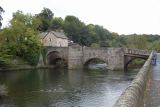
Ludford Bridge (© Mr M Evison and licensed for reuse under this Creative Commons Licence)
Battle of Ludford Bridge/Ludlow, Shropshire, won by the Lancastrians.
Warwick’s re-inforcements from the garrison of Calais under Andrew Trollope defected to the Lancastrians. The Yorkist leaders fled, York and Rutland to Ireland, and Edward, Earl of March (York’s eldest son), Richard Neville, Earl of Salisbury, and his son Richard Neville, Earl of Warwick, to Calais. After the battle Cecily, Duchess of York, and her three youngest children George, Margaret and Richard, were taken prisoner by the Lancastrians and placed into the care of Cecily’s older sister Anne, Duchess of Buckingham.
A short description of the various battles of the Wars of the Roses can be found on the website of the Richard III Society.
Tags: Battles, Edward IV, Family, Henry VI, Richard III
Comments Off on 12 OCTOBER 1459
 Richard III hears of an uprising in Kent, followed the next day with the news that Henry Stafford, second duke of Buckingham, had turned against him. Buckingham’s rebellion mainly failed due to lack of support for him and bad weather.
Reference:
- S. L. Davies, ‘Stafford, Henry, second duke of Buckingham (1455–1483)’, Oxford Dictionary of National Biography, Oxford University Press, 2004. [accessed online 3 Feb. 2011]
Tags: Buckingham, Richard III
Comments Off on 10 OCTOBER 1483
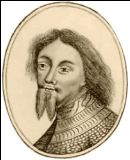 At a meeting of Parliament Richard Plantagenet, 3rd Duke of York, claims his right to the English crown. A compromise is reached and sworn on in an Act of Accord, according to which the Duke of York is the heir to the throne instead of Henry VI’s son Edward.
Tags: Family, Henry VI, Richard Duke of York
Comments Off on 10 OCTOBER 1460
Truce of Hesdin between Edward IV of England and Louis XI of France. In it, Louis renounced all aid to the Lancastrians.
Reference:
Diana E. S. Dunn, ‘Margaret (1430–1482)’, Oxford Dictionary of National Biography, Oxford University Press, 2004. [accessed online 20 Jan. 2011]
Tags: Edward IV, France, Margaret of Anjou
Comments Off on 8 OCTOBER 1463
Birth of Richard, the infant son of George, duke of Clarence, and Isabel Neville. His mother had died on 22 December 1476, two and a half months after his birth. Richard died a few days later on 1 January 1477.
Tags: George of Clarence, Isabel Neville
Comments Off on 6 OCTOBER 1476
Happy Birthday, Richard!

Fotheringhay Castle (photo by Smb1001, via Wikimedia Commons)
Richard, the youngest surviving child of Richard Plantagenet, 3rd Duke of York, and Cecily Neville, was born at Fotheringhay Castle, Northamptonshire, on 2 October 1452. He would ascend the throne in 1483 as Richard III.
Tags: Richard III
Comments Off on 2 OCTOBER 1452
 Edward IV flees to Burgundy, after the rebels under Earl of Warwick, who had by then sided with his former enemy Margaret of Anjou, invaded England with the help of French troops to restore Henry VI. Edward was accompanied by his brother-in-law Anthony, Earl Rivers, and William Lord Hastings. It seems his brother Richard (later Richard III) followed later after trying to gather to support for Edward in England.
Tags: Edward IV, Nevilles, Richard III
Comments Off on 29 SEPTEMBER 1470